Beyond the HAVS Hand Arm Vibration
Managing Hand-Arm Vibration Syndrome (HAVS) is a central health and safety requirement under HSE directives for councils, contractors, and public sector bodies. Protecting grounds staff while maintain
Understanding Duty of Care Under HSE Directives for HAVS
Under the Control of Vibration at Work Regulations 2005, employers have a strict legal duty of care to assess and control risks from hand-arm vibration. Continuous exposure to high vibration levels can lead to permanent neurological and vascular damage—commonly known as HAVS or Vibration White Finger.
To comply with HSE directives, fleet managers and safety officers must monitor trigger times based on two main thresholds:
- Exposure Action Value (EAV): 2.5m/s² – The daily threshold where employers must implement technical and organizational measures to reduce exposure.
- Exposure Limit Value (ELV): 5.0m/s² – The absolute maximum exposure level an operative can experience in a single day.
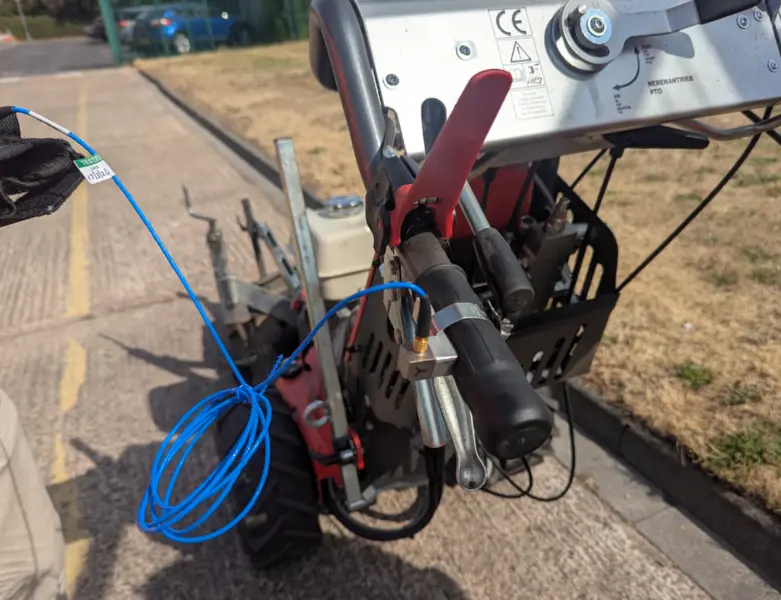
But how do you know what a specific machine exposes an operator to?
When purchasing ground care machinery, standard declaration values often rely on factory test conditions. This is where the K-factor comes in.
- What is a K-factor? The K-factor is a manufacturer’s declared measurement uncertainty value added to standard vibration test results. It accounts for minor production variances and factory test conditions, giving a theoretical upper boundary of expected vibration under controlled settings.
- The Limitation: Factory tests often take place in a non work situation i.e. the machine running but out of work. They rarely reflect the actual vibration fed through an operative's hands during an 8-hour shift on uneven pavements or heavy turf.
Why Kersten UK Provides Real-World Vibration Data
At Kersten UK, we replace theoretical K-factor estimates with transparent, real-world vibration testing. By measuring actual magnitude under active site conditions, we provide local authorities and contractors with reliable data. This allows health and safety officers to calculate realistic trigger times, keeping operatives safe without relying on guesswork.
Why are the static HAVS levels lower than competitive machines?
- Because the construction of the machine contains more steel with bends junctions and shapes which helps to stop vibrations from travelling.
- Antivibration dampening in the right places. The current designs for each model come from years of experience, understanding how to manage a specific element. Proactively reduce the causes and isolate the remaining effects.
- Large wheels with pneumatic tyres and robust tread pattern
- Robust handlebars with special handgrips and drive controls to reduce vibration and operator fatigue
But this is not the whole story.....
Regular Surface Maintenance as a HAVS Control Measure
Under HSE directives, employers must follow the Hierarchy of Controls to reduce vibration exposure to as low a level as reasonably practicable. While changing tools is often the first thought, altering operational strategy is equally effective.
Why Maintenance Frequency Belongs in Your Risk Assessment
Your HAVS risk assessment shouldn't just look at machine selection—it should consider site management:
- Lower Mechanical Load: Sweeping or weed-brushing a surface regularly prevents thick moss, compacted soil, and deep-rooted weeds from keying into hard surfaces.
- Vibration Reduction: Operating on a maintained surface drops the vibration level from hypothetical 4.0–4.5 m/s² down to ~3.0 m/s², significantly increasing an operative's safe trigger time.
- Reasonable Practicability: Incorporating routine maintenance schedules into site risk assessments demonstrates a proactive strategy to reduce risk at the source rather than relying strictly on restrictive operator time limits.
By shifting from reactive clearing (high vibration) to proactive maintenance (low vibration), local authorities and contractors can protect staff health while maximizing daily operational productivity.
How Task Severity Influences Brush Vibration
The vibration levels transmitted by powered pedestrian sweeper brushes vary considerably depending on work intensity, weather, and seasonal ground conditions.
Light Maintenance vs. Heavy Seasonal Clearing
| Condition Types | Environmental Factor | Brush Behaviour & Vibration Impact |
| Light, Regular Work | Daily/weekly maintenance; dry loose dust, light litter, thin leaf scatter. | Lower Vibration: The brush glides smoothly across the surface. Low surface resistance means minimal force feedback to the power unit handles, extending safe operator trigger times. |
| Infrequent Clearing | Unmaintained areas; heavy moss accumulation, thick wet leaf carpet, or packed debris. | Higher Vibration: High mechanical resistance requires greater downforce and engine load. The brush repeatedly impacts dense material, transmitting increased vibration to the handles. |
| Dry, Caked-On Material | Summer drought conditions; mud or earth dried and baked onto hard paving. | Maximum Vibration: Bristles flick against rigid, unyielding surfaces rather than sweeping through loose debris. Resistance spikes, increasing feedback through the frame to the operator. |
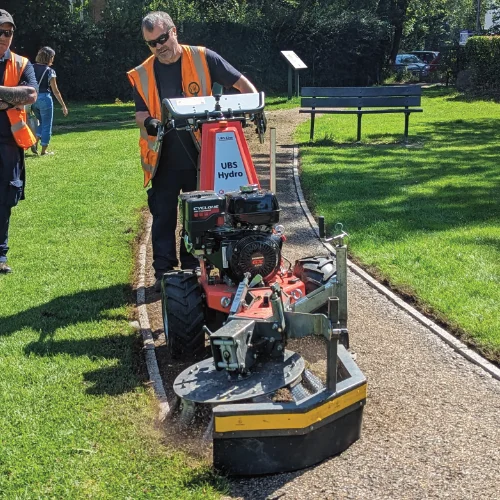
Case Study: The Kersten UBS 13 Hydro with WBK60 Weedbrush
A prime example of why real-world testing matters is the Kersten UBS 13 Hydro pedestrian tractor equipped with the WBK60 weedbrush.
- Manufacturer Stated Value:
< 2.5 m/s² - Real World Static Running (Not in Work):
~1.5 m/s² - Real World Standard Work (Regularly Maintained Surface):
~3.0 m/s² - Real World Heavy Soiling (Rough Surface / Heavy Weed & Soil Accumulation):
3.5 – 4.0 m/s²
If a safety officer relies solely on the declared manufacturer figure of < 2.5 m/s², they might assume an operative can use the machine for a full 8-hour shift without reaching the Exposure Action Value (EAV). However, in heavy soiling conditions, real-world readings of 3.5 - 4m/s² mean an operative reaches their daily action limit in roughly 4 hours. or It is in the gift of the operator to adjust the machine to function at a level which operates at a balance of workrate vs vibration exposure.
Of course if a machines start with a manufacturers stated value of 4.5m/s² then the real world value is likely to be higher. Simpler machines generally have less scope to adjust the above workrate vs vibration balance.
But this is not the whole story...
Hand tools vs Small machine vs Larger machine
Starting from a baseline where a non-powered hand tool (hoe, shovel, broom) has a stationary HAVS value of 0 m/s² and the stationary machine value is ~1.5 m/s², the key factor isn't just instantaneous vibration—it is work speed and exposure time per linear metre covered.
Because HAVS risk is a function of magnitude (metres/second squared) multiplied by time (hours), doing work faster drastically reduces the total vibration dose received per metre of ground cleared.
The Operational Trade-Off: HAVS vs. Total Risk
While a manual tool emits zero mechanical vibration, comparing them per metre reveals important health and safety considerations for fleet management:
- Time Exposure Ratio: Clearing a 500-metre path manually requires nearly an entire 8-hour shift of intensive manual labour. A pedestrian weedbrush clears that same 500 metres in roughly 20–30 minutes.
- Low Point Accumulation: Because the machine works so much faster, the operator accumulates very few HSE points per metre. At 3 m/s² a 10-minute pass accumulates under 3 HSE points out of the 100-point daily Exposure Action Value (EAV) threshold.
- Trade-off with Ergonomic Strain: Replacing machines entirely with hand tools trades HAVS risk for Musculoskeletal Disorders (MSDs), back injuries, and RSI caused by hours of repeated scraping, sweeping, and lifting.
Inclusion for Your Risk Assessment
"While manual hoes and brooms carry zero HAVS vibration rating, their low rate of work dramatically increases operative labour hours per metre. A powered unit increases the instantaneous vibration rate to ~3.0 m/s², but reduces time-on-task by over 90% per metre cleared. Therefore, using powered weedbrushes for routine maintenance minimizes total physical strain (MSDs) while keeping HAVS point accumulation per linear metre extremely low."
| Impact & Exposure Factor | Manual Steel Shovel / Scraper | Kersten UBS 13 + WBK60 Weedbrush |
| Source of Force | Human muscle force driving hard steel against coarse tarmac aggregates. | Engine power driving a rotating brush fitted with flexible, damped wire bristles. |
| Physical Vibration & Shock | High transient shock spikes every time the blade hits a stone chip, seam, or curb edge. | Continuous harmonic vibration (measured at ~3.0 m/s² in regular work). |
| Operator Interface | Rigid metal/wooden shaft held with a tight grip; no vibration dampening. | Anti-vibration mounted handlebars designed to isolate engine and brush feedback. |
| Coverage Rate | ~0.5 metres per minute (requires repeated heavy striking and scraping). | ~20 metres per minute (smooth, continuous forward walking pace). |
| Body Strain Path | Direct impact transferred into hand, wrist, and shoulder joints + severe lower back shear stress. | Sustained lower-magnitude input isolated primarily to the hands/forearms. |
The Risk Assessment Perspective
If a safety assessment replaces a powered weedbrush with manual scraping to "eliminate HAVS," it often creates a worse overall risk profile:
- Shock Transfer: While a manual shovel emits no motor vibration, the repeated jarring impact against rigid tarmac delivers peak forces to the joint cartilage that are physically harsher per stroke than a damped machine handle.
- Musculoskeletal Disorder (MSD) Risk: Manual scraping requires high grip force combined with spinal flexion and twisting. MSD claims (back injuries, wrist tendinitis, shoulder impingement) far outnumber HAVS claims in manual ground care.
- Time Exposure Factor: An operative spends 40 times longer holding and striking a shovel to cover the same metreage as a pedestrian tractor, multiplying the duration of joint strain.
The Kersten machine introduces a managed, measurable motor vibration level (~3.0 m/s²), but it eliminates manual impact shock, cuts physical strain, and reduces work time per metre by roughly 95%.
The larger and heavier the power unit the lower the vibration and physical strain.
Find out more about the Kersten UBS two wheel tractors range here...
Find out more about Kersten Weedbrush products here.....
Or contact us 0118 9869 253

Chris Faulkner
Chris is Managing Director of Kersten UK Ltd Interested in weed control solutions and machinery
No comments yet. Login to start a new discussion Start a new discussion